


News
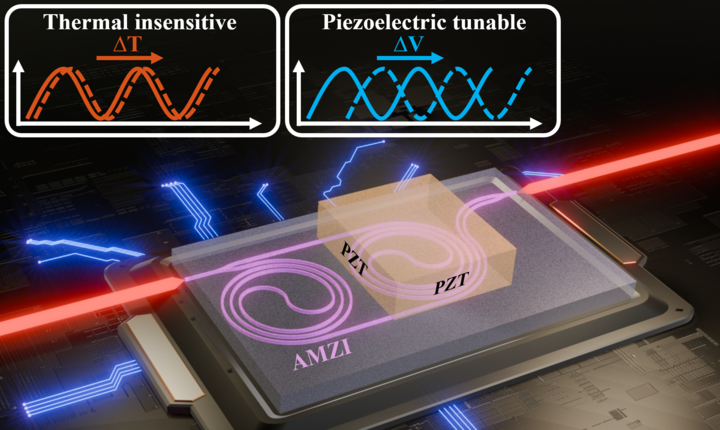
[2026/10/15] Our paper was published in Advanced Photonics Research
We demonstrate a tunable athermal Mach–Zehnder interferometer (AMZI) fabricated in the tantalum pentoxide (Ta2O5) platform and actuated by a lead zirconate titanate (PZT) chip. Athermalization is achieved through the structural compensation method and postfabrication trimming by a PZT actuator, yielding an intrinsic temperature-dependent wavelength shift (TDWS) of 6.2 pm/K and a record-low TDWS of 0.49 pm/K near 1550 nm with piezoelectric trimming. The PZT-bonded AMZI exhibits a piezoelectric tuning efficiency of −58.5 pm/V and a 3 dB bandwidth of 2.6 kHz. Leveraging this tunability, the residual TDWS of the AMZI could be suppressed to sub-pm/K level.
The paper can be accessed on the Advanced Photonics Research website.

[2026/8/15] Mr. Ziming Zhang won Excellent Poster Award
Mr. Ziming Zhang received Excellenth Poster Award at the 5th Silicon-Based Optoelectronics (Silicon Photonics) Innovation Forum. His poster title is "Four-waveMixing in Tantalum Pentoxide-loaded LNOI High Q Microresonators".
The Forum was held in Guangzhou, 2026
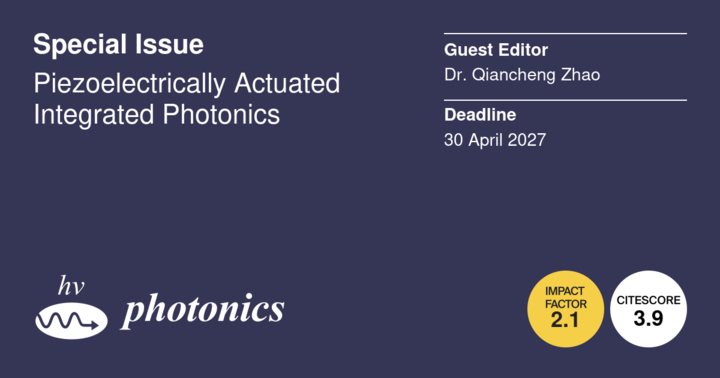
[2026/07/05] New Speical Issue open for submission
This Special Issue focuses on the state-of-the-artadvancements in piezoelectrically actuated integrated photonics, with a broader aim of presenting novel design methodologies, device architectures, and fabrication techniques, and cutting-edge applications. We welcome submissions in any format, including original research articles, reviews, letters, and perspectives.
Details of the Special Issue can be found here.

[2026/3/17] Our paper was published in ACS Photonics (Supplementary Cover)
We demonstrate the first backward SBS in tantalum pentoxide (Ta2O5) waveguides, revealing a Brillouin gain of 4.9 m^–1 W^–1 at Brillouin frequency shift of 11.23 GHz. The strong nonlinear refractive index of 7.8×10^–19 m^2/W supports efficient supercontinuum generation (SCG) and four-wave mixing (FWM) in dispersion-engineered strip and rib waveguides across both anomalous and normal dispersion regimes. In the anomalous dispersion regime, SCG exceeding 300 nm is realized and theoretically extendable to over 1100 nm. FWM experiments exhibit a conversion efficiency of −48.1 dB and a potential bandwidth of 120 nm. In the normal dispersion regime, a flat supercontinuum spanning over 180 nm with power fluctuations below 15 dB is generated, serving as a broadband source for acetylene gas spectroscopy. These results highlight its exceptional versatility for multifunctional integrated nonlinear photonics.
The paper can be accessed on the ACS Photonics website.

[2026/3/6] Our paper was published in Advanced Photonics Research (Cover Feature)
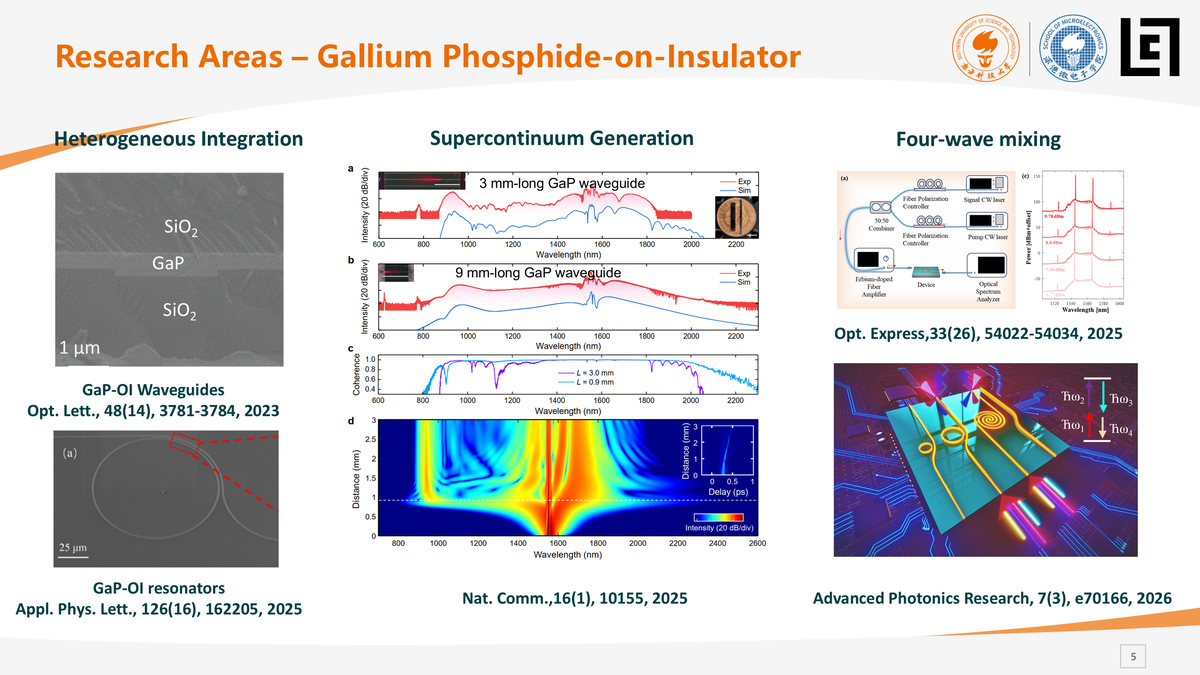
The four-wave mixing conversion efficiencies of both the waveguides and the microresonators exhibit a well-correlated relation versus their effective lengths, confirming the unified theoretical framework. These experimentally validated findings offer a fresh perspective on Kerr nonlinearity and pave the way toward advancing the development of highly efficient nonlinear photonic devices and products. In this work, we propose a different perspective that FE can be interpreted as an elongation of effective length. Moreover, we establish a unified framework that bridges nonresonant waveguides and resonant cavities through this generalized effective length concept. We validate the model experimentally using direct-bonded gallium phosphide-on-insulator waveguides and microresonators.
This paper can be accessed on the Advanced Photonics Research website.
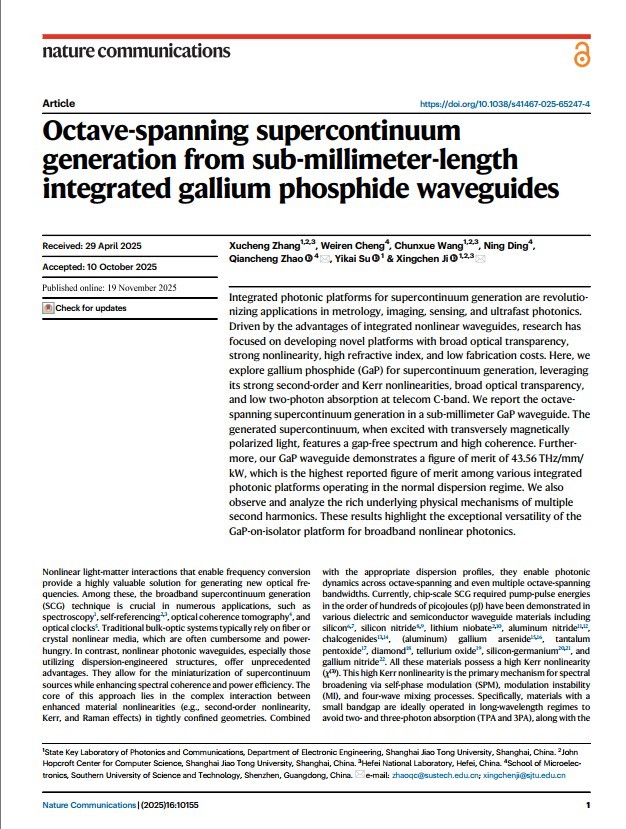
[2025/11/19] Our paper was published in Nature Communications
Here, we explore gallium phosphide (GaP) for supercontinuum generation, leveraging its strong second-order and Kerr nonlinearities, broad optical transparency, and low two-photon absorption at telecom C-band. We report the octave-spanning supercontinuum generation in a sub-millimeter GaP waveguide. The generated supercontinuum, when excited with transversely magnetically polarized light, features a gap-free spectrum and high coherence. Furthermore, our GaP waveguide demonstrates a figure of merit of 43.56 THz/mm/kW, which is the highest reported figure of merit among various integrated photonic platforms operating in the normal dispersion regime. We also observe and analyze the rich underlying physical mechanisms of multiple second harmonics. These results highlight the exceptional versatility of the GaP-on-isolator platform for broadband nonlinear photonics.
The paper can be accessed on the Nature Communications website.
RESEARCH
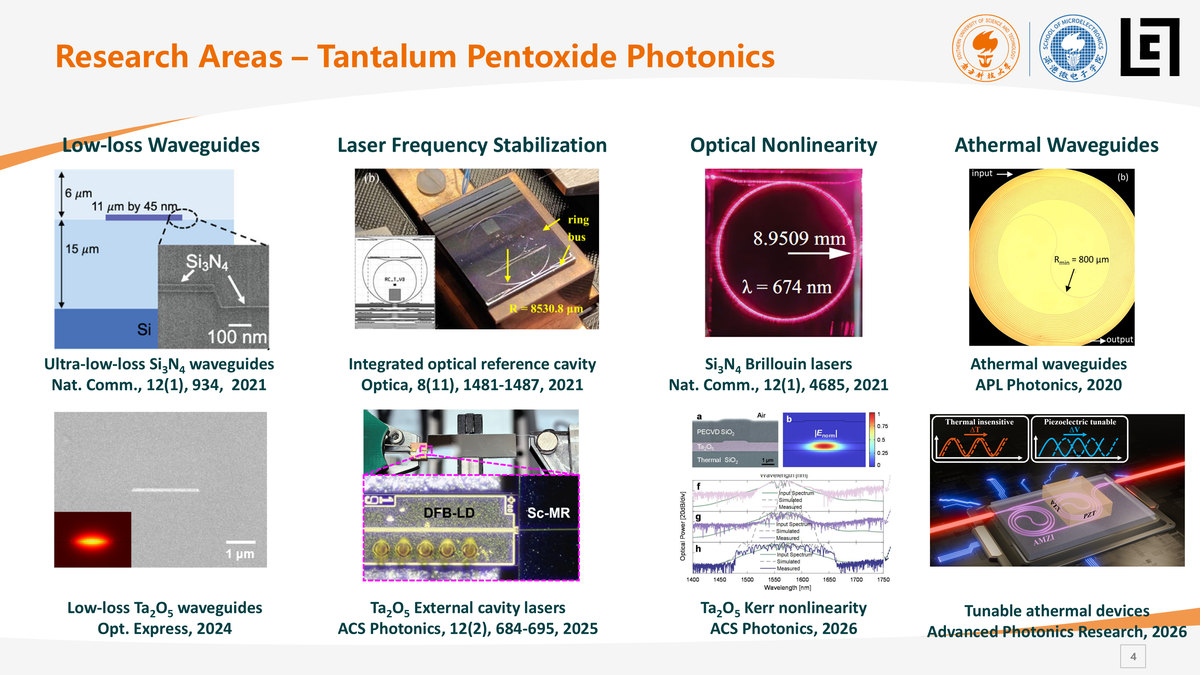
Tantalum pentoxide integrated photonic
Tantalum pentoxide (Ta2O5) is a versatile photonic material that is compatible with silicon photonics. It has a moderate refractive index, low propagation loss, a non-negligible third-order nonlinearity, a small thermo-optic coefficient, and a strong SBS gain. Thus it is widely used in passive photonic devices for optical interconnecting, nonlinearity, and bio-photonic applications. Integrating functional components empowers tantalum pentoxide passive devices with unprecedented functionalities that could only be realized in active photonic devices, opening new possibilities for a whole new class of integrated devices and systems.
Gallium phosphide-on-insulator integrated photonics
Gallium phosphide (GaP) has been increasingly prioritized, fueled by the enormous demands in visible light applications such as biomedical and quantum technologies. GaP has garnered tremendous attention in nanophotonics thanks to its high refractive index, indirect bandgap width of 2.26 eV, lattice perfectly matched with silicon, and omnipotent and competitive nonlinear optical properties. The advent of gallium phosphide-on-insulator (GaP-OI) architecture unleashes the material’s potential in nonlinear applications, offering both strong mode confinement and seamless fabrication compatibility with silicon photonics.
TEAM

Qiancheng Zhao
赵前程
PI
zhaoqc@sustech.edu.cn

Weiren Cheng
程炜仁
PhD
12231169@mail.sustech.edu.cn

Zhenyu Liu
刘振宇
PhD
12331328@mail.sustech.edu.cn

Jiaxin Hou
侯甲欣
PhD
12441004@mail.sustech.edu.cn

Mingjian You
游铭坚
PhD
12333354@mail.sustech.edu.cn

Ning Ding
丁宁
PhD
12333314@mail.sustech.edu.cn

Shangyu Wang
王尚宇
PhD
12312621@mail.sustech.edu.cn

Junke Zhou
周峻珂
Master
12011712@mail.sustech.edu.cn

Qiwei Zheng
郑淇玮
Master
12532766@mail.sustech.edu.cn

Shengjie Liu
刘圣捷
Master
12532815@mail.sustech.edu.cn

Jiazhao He
何家兆
Master
12211729@mail.sustech.edu.cn

Linyuan Yang
杨淋渊
Master
12210905@mail.sustech.edu.cn

Wenze Zhao
赵文泽
Bachelor
12313530@mail.sustech.edu.cn

Haoxuan Shi
石浩轩
Bachelor
12311618@mail.sustech.edu.cn

Rui Qiu
邱瑞
Secretary
qiur@mail.sustech.edu.cn
ALUMNI

Houling Ji
姬厚领
Graduated in 2023 with a master's degree
After graduation: Joint PhD of SUSTech and Pengcheng Lab

Zhuoyu Yu
余卓宇
Graduated in 2024 with a bachelor's degree
After graduation: Master of Philosophy in the Hong Kong Polytechnic University

Zhaoting Geng
耿兆珽
Graduated in 2024 with a bachelor's degree
After graduation: PhD in Hong Kong University

Pengzhuo Wu
吴鹏焯
Graduated in 2024 with a master's degree
After graduation: BYD Company

Yihan Liu
刘逸涵
Graduated in 2025 with a bachelor's degree
After graduation: Master in SUSTech

Xiaolun Yu
余晓伦
Graduated in 2025 with a bachelor's degree
After graduation: Master in SUSTech

Xingyu Tang
汤星宇
Graduated in 2026 with a master's degree
After graduation: PhD in the Chinese University of Hong Kong (Shenzhen)

Naiqin Bu
布乃勤
Graduated in 2026 with a bachelor's degree
After graduation: PhD in the City University of New York


